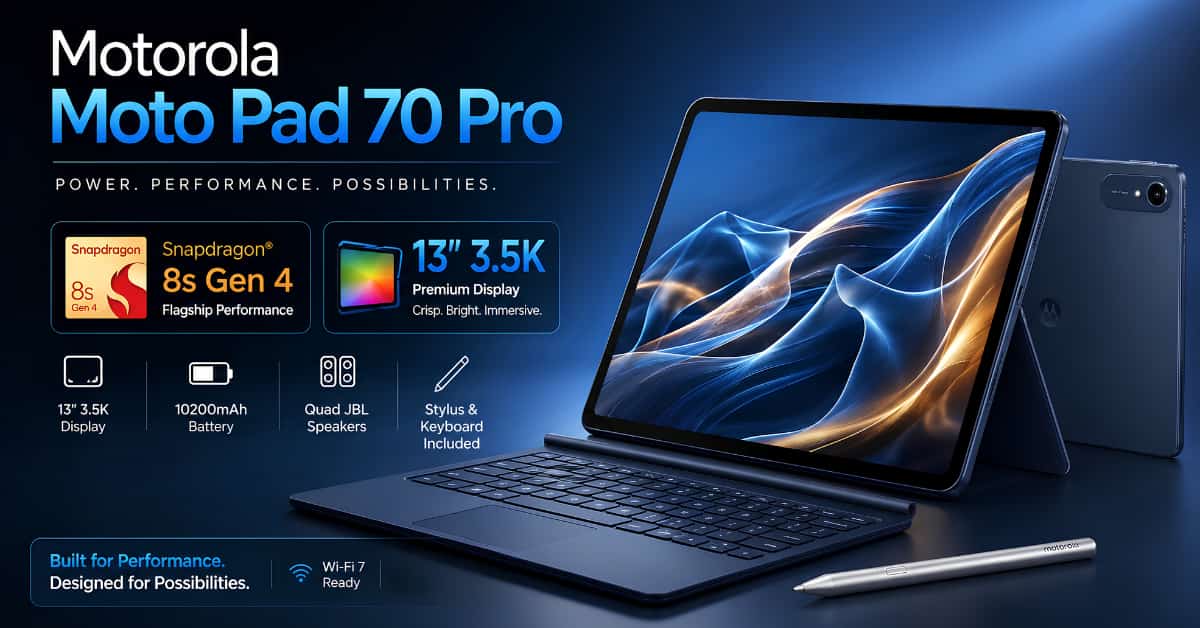
The Moto Pad 70 Pro is priced where tablets play it safe. It refuses to act like it.
By M Akshay | Published: June 27, 2026 | Updated: June 27, 2026 |
Spending time with the Moto Pad 70 Pro, even before it officially goes on sale, makes one thing obvious: Motorola did not sit down and ask how to make a good mid-range tablet. They asked how to make their rivals look overpriced. Those are two very different design briefs, and the resulting product behaves accordingly.
India’s tablet market in 2026 has become a strange place. Devices at the ₹30,000–₹40,000 mark either squeeze flagship specs into compromised displays, or give you a beautiful screen sitting on last season’s chip. The Moto Pad 70 Pro refuses both compromises. It arrives with a 13-inch 3.5K display running at 144Hz, a Snapdragon 8s Gen 4 chip that benchmarks above everything in its price class, and a stylus packed inside the box, free, while competitors charge ₹8,000 or more for theirs separately.
That stylus detail alone reframes the purchase decision for an enormous number of buyers. Students doing handwritten notes. Designers sketching rough ideas. Professionals annotating contracts. All of them were quietly accepting that a pen-capable tablet meant budgeting extra. Not anymore.
When a product makes its competition look like they forgot to try, you notice. The Moto Pad 70 Pro has that energy from the moment you pick it up.
A Screen That Earns Every Millimetre of Its 13 Inches
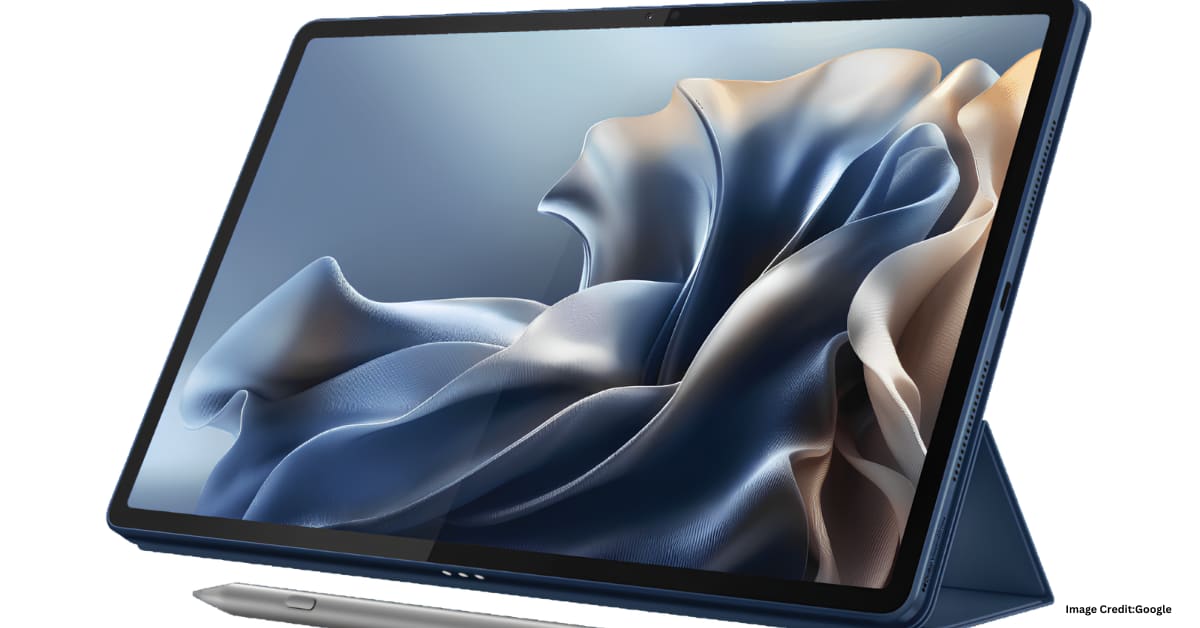
Large-format displays on budget tablets usually come with a trade-off hiding somewhere, washed-out colours, a 60Hz panel that stutters during fast motion, or brightness that collapses the moment you step into natural light. The Moto Pad 70 Pro sidesteps all three. Its 3.5K resolution works out to 319 pixels per inch, which means text at any size reads cleanly, and fine detail in illustrations or spreadsheets doesn’t dissolve into blur when you zoom out.
The 144Hz refresh rate is paired with Dolby Vision HDR and 99% DCI-P3 colour accuracy, a combination you typically find on devices costing ₹60,000 and above. At 800 nits of high-brightness mode output, the display handles sunlit rooms without becoming a mirror. What does all of this mean for daily use? Streaming a colour-graded film on this panel looks genuinely different from watching the same content on a 1080p 60Hz competitor. The gap is visible, not theoretical.
Then there is the physical package holding the screen. At 6.2mm, the Moto Pad 70 Pro is astonishingly thin for a device carrying a 10,200 mAh battery and a full metal body. Weighing 589 grams across 13 inches, it distributes mass evenly enough that single-handed reading, lying down, sitting on a train, doesn’t feel like a workout. The Pantone Titan colourway reads as a dark blue-grey that avoids the generic silver-or-space-grey binary most tablets default to.
DISPLAY CONTEXT: The Moto Pad 70 Pro’s panel spec (3.5K, 144Hz, Dolby Vision) matches or exceeds tablets priced ₹20,000 higher in India. At this screen size and resolution, there is currently no direct Android competitor in this price band.
Also, read | Nothing Phone 4b Design Officially Revealed – Transparent Back Is Back and It Looks Stunning
What Snapdragon 8s Gen 4 Actually Feels Like When AI Runs On-Device
The performance conversation around tablets is usually straightforward: faster chip, smoother multitasking. The Moto Pad 70 Pro adds a third dimension, what happens when the chip is powerful enough to run AI workloads entirely on the device, without a data connection and without sending your content to a cloud server.
The Moto Pen Pro, which ships inside the box, is where this becomes tangible. Draw a rough map, a diagram, or a layout concept on the screen. The Sketch to Image feature processes it locally and returns a finished visual interpretation. Record a meeting or lecture. AI Live Transcript produces a real-time text version without buffering or uploading. Snap a photo with the 13 MP rear camera. AI Super Resolution reconstructs lost detail. These aren’t cloud-dependent magic tricks that stop working when your Wi-Fi drops; they’re processed by the Snapdragon 8s Gen 4’s NPU, which Motorola’s 2.5 million AnTuTu claim suggests is doing serious work.
Away from the stylus, the Smarter Reader tool lets you highlight any text on screen, a news article, a textbook chapter, an email in Hindi, and immediately get a summary, a translation, or a plain-language explanation. AI Notes organises your handwritten or typed content into structured, searchable entries. Smart Capture frames and saves content automatically when you’re browsing. These features exist on flagship Android devices. The Moto Pad 70 Pro delivers them at a price point where buyers are usually choosing between specs and screen size, not expecting both plus an AI toolkit.
Gaming deserves a mention, though it isn’t the device’s primary personality. The three-layer thermal architecture inside the chassis keeps the chip stable under extended load. Motorola claims 120fps in supported games, and the 13-inch display makes that frame rate meaningful in a way that no 6-inch phone screen replicates. This is a secondary use case that the hardware handles without complaint.
On-device AI that works without a data connection isn’t a feature list bullet point. It’s the difference between a tool you use and a tool you depend on.
Battery Life, Long-Term Software, and Why the Pricing Is the Real Story
Let’s address the battery calculation that doesn’t make intuitive sense: how does a 6.2mm aluminium tablet contain 10,200 mAh of charge? The answer is high-density cell stacking, an engineering technique that trades internal volume efficiency for thinner individual cells arranged in layers. The result is a tablet that, according to Motorola’s own testing, delivers up to 15 hours of continuous video playback. That claim is aggressive, but even a conservative real-world figure of 10 to 12 hours covers a full working day without requiring a power socket.
The 45W TurboPower fast charging brings the depleted battery back to a functional level inside 45 minutes. More interesting is the charger that ships in the box, rated at 68W, which is higher than what the tablet’s own charging spec requires. Motorola is giving buyers a charger that future-proofs their USB-C setup even beyond this device.
Android 16 is the operating system at launch, with a committed upgrade path to Android 19. Security patches are guaranteed through 2030. Taken together, this means a buyer picking up the Moto Pad 70 Pro today is looking at a device with meaningful software support through 2030, four years of relevance in a product category that often drops support after two. For students currently starting a degree, or professionals buying a device for a specific project lifecycle, this commitment changes the value calculation significantly.
Wi-Fi 7 and Bluetooth 6.0 are connectivity specs most competing tablets in this range haven’t adopted yet. Wi-Fi 7 delivers faster throughput and lower latency on supported routers, important for video calls, cloud gaming, and transferring large files. Bluetooth 6.0 enables more stable connections to peripherals. These aren’t headline features, but they extend the device’s relevance as infrastructure around it upgrades.
Now the pricing, which is where everything crystallises. The base 8 GB + 128 GB configuration is ₹36,999. The 256 GB variant costs ₹39,999. The keyboard bundle, which adds a full QWERTY layout with trackpad, a Smart Key for AI shortcuts, and Desk Mode support, is ₹45,999. ICICI Bank cardholders receive ₹4,000 off at checkout for a limited period, making the effective entry price ₹32,999. The keyboard is also purchasable separately at ₹5,999 alongside the 256 GB model. Everything goes on sale July 4, 2026, on Flipkart, Motorola.in, and retail stores across India.
BUY SMART: The ₹39,999 + ₹5,999 keyboard path (total ₹45,998) gives you the 256 GB UFS 4.0 storage model with the keyboard — functionally identical to the ₹45,999 bundle but lets you choose timing. With the ICICI discount, the 256 GB base config drops to ₹35,999.
Who Should Actually Buy This, and Who Should Think Twice
The Moto Pad 70 Pro makes the most sense for three kinds of buyers. First: students who need a single device that handles note-taking (with the included pen), lecture transcription (with AI Live Transcript), document reading (with Smarter Reader), and entertainment, all without carrying a laptop and a tablet separately. Second: working professionals whose laptop use is mostly document work, video calls, and email, and who want something lighter and more portable without sacrificing screen size. Third: content consumers, people who watch a lot of video, listen to music, and occasionally do light creative work, for whom the 13-inch Dolby Vision screen and JBL quad-speaker Dolby Atmos audio make the experience noticeably better than any competitor in this range.
Who should pause: buyers who shoot a lot of 4K video and need local storage will feel the 128 GB base model’s limits quickly. The microSD slot saves you from a storage crisis, but onboard speed matters for video editing. Go for the 256 GB variant if media production is part of your workflow. Also, buyers who need a cellular connection for remote work without Wi-Fi should note that current confirmed specs indicate Wi-Fi only, cellular connectivity has not been announced for the Indian market launch.
One more honest observation: the 13-inch form factor is not for everyone. It is genuinely large. Single-handed use for extended periods is manageable at 589 grams. Still, readers who want something that feels like a large phone, is pocketable, and can be held with one hand at a moment’s notice will find 11-inch competitors more ergonomic. The Moto Pad 70 Pro is a desk-and-bag device, not a pocket device. If your usage reflects that, it rewards you generously.
Final Assessment: Is the Moto Pad 70 Pro Worth It?
The Moto Pad 70 Pro doesn’t succeed because it has more specs than competitors at this price. Plenty of devices play that game and remain forgettable. It succeeds because it makes a coherent argument: here is a device that respects your money, your time, and your intelligence. The display doesn’t make excuses. The chip doesn’t hold back. The pen doesn’t cost extra. The software doesn’t expire in eighteen months.
At ₹36,999 or ₹32,999 with the bank discount, this is the Android tablet that earns a serious recommendation without the usual asterisks. It goes on sale July 4. If the specs above match what you need, there isn’t a compelling reason to wait for something else.
RATING: 9.2 / 10 Exceptional value. Unmatched display for the price. AI tools that earn their place. The one tablet in 2026 that makes you feel clever for buying it.
Quick-Reference Specs
| Display | 13″ 3.5K LCD · 3504×2190 · 144Hz · 800 nits HBM · 319 ppi · Dolby Vision · 99% DCI-P3 |
| Chipset | Snapdragon 8s Gen 4 · AnTuTu 2.5M+ · 3-layer AI thermal system |
| RAM / Storage | 8 GB LPDDR5X · 128 GB (UFS 3.1) or 256 GB (UFS 4.0) · microSD up to 2 TB |
| Battery | 10,200 mAh · 45W TurboPower · 68W charger included in-box |
| Audio | Quad JBL speakers · Dolby Atmos |
| Cameras | 13 MP rear · 8 MP front |
| OS | Android 16 out-of-box · Android 19 guaranteed · Security updates to 2030 |
| Connectivity | Wi-Fi 7 · Bluetooth 6.0 · microSD · USB-C |
| Design | 6.2 mm thin · 589 g · Full-metal chassis · Pantone Titan shade |
| In-box extras | Moto Pen Pro (AI-powered stylus) — included free |
| Pricing | ₹36,999 (128 GB) · ₹39,999 (256 GB) · ₹45,999 (with snap-on keyboard) |
| Bank offer | ₹4,000 instant discount for ICICI Bank cardholders → effective ₹32,999 |
| On sale | July 4, 2026 · Flipkart · Motorola.in · Major retail stores, India |
Tags: Moto Pad 70 Pro · AI Tablet India 2026 · Snapdragon 8s Gen 4 · Best Android Tablet Under 40000 · Moto Pen Pro · Motorola Tablet Launch · JBL Dolby Atmos Tablet · Android 16 Tablet India
Latest Posts

Samsung Galaxy F70 5G Launched in India: Price, Specifications, and Is It Worth Buying?

Flipkart Big Billion Days Sale 2026: Best Deals on Smartphones, Laptops, TVs and More
Samsung Galaxy A56 5G Review: Is This the Best Mid Range Samsung Phone You Can Buy Right Now
Vivo V80 5G India Launch on October 6: Price, Specifications, Camera and Battery Details
Poco M8 Power 5G Price In India Review: Big Battery, Bright Display, But Here Is What It Skips

Fitbit Air Launched in India at Rs 13,999: Price, Features, and How It Compares to Whoop 5

One UI 9 Update Rolling Out to Galaxy S26: New Features, Rollout Status, and How to Download

Realme 16 Pro Harry Potter Edition: Price, Design, and Everything Fans Should Know Before Buying
Redmi Note 17 Pro and Pro Max Launched in India: Price, Specifications, and Everything Worth Knowing

Microsoft Humanist AI Code of Conduct Explained: Why the Company Is Choosing Safety Over Speed

GPT-6 Astra Explained: What OpenAI’s Most Powerful Model Can Actually Do