Written by M. Akshay | Founder, Bestructure.com Published: July 04, 2026 | Last Updated: July 15, 2026
Every few years, a product comes along in the home audio space that doesn’t just improve on what came before, it quietly rewrites the rulebook for what a “normal” setup should look like. For soundbars, that product is the JBL Bar 800 Pro. Priced at ₹49,999, it’s not the cheapest option on the shelf, but once you understand the engineering decisions behind it, the price starts to make a lot more sense.
Let’s walk through what makes this system tick, piece by piece.
Rethinking Rear Speakers From the Ground Up
Ask anyone who has ever tried to set up a proper surround system at home, and they’ll tell you the same story: the front speakers are easy, but the rear channels are a nightmare. You either run a wire the entire length of your room, hide it under furniture, or give up entirely and settle for a soundbar that just pretends to have surround sound using audio processing tricks.
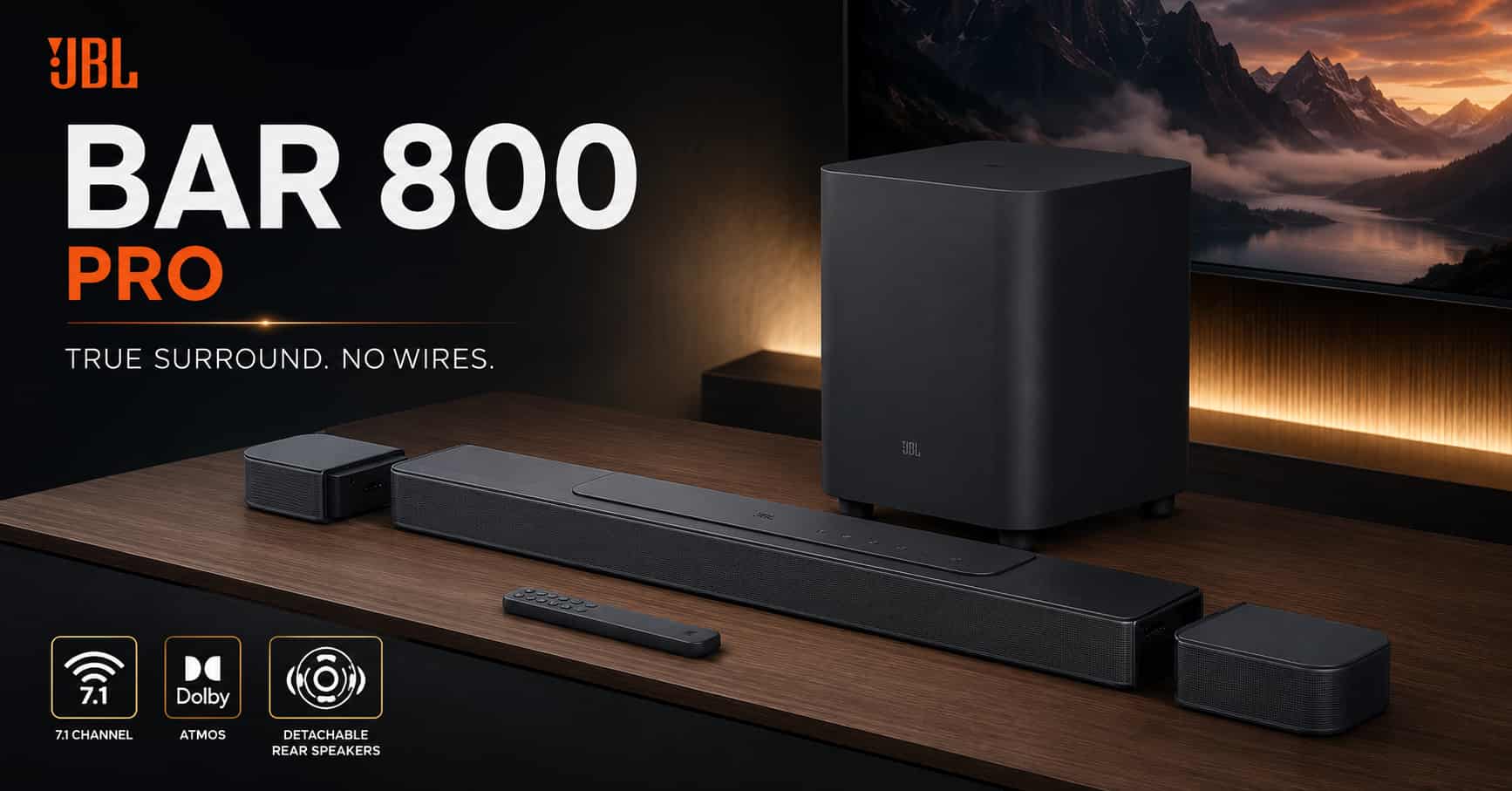
JBL’s engineering team solved this differently with the Bar 800 Pro. The left and right ends of the main unit are actually separate speaker modules that click off magnetically. Pick them up, carry them to the back of your seating area, place them on a shelf or side table, and you’ve got real rear-channel audio, no wire, no extra outlet needed, since they run on internal batteries. Movie’s over? Snap them back onto the main bar, where they recharge automatically and switch to acting as a wider front stereo image for daily viewing.
It sounds like a small mechanical trick, but it fundamentally changes how usable “real” surround sound is in an average Indian living room, where drilling holes or hiding cable runs isn’t always practical.
Overhead Audio That’s Built, Not Faked
Here’s something worth knowing before you shop for any Atmos-branded soundbar: a lot of them fake the height effect entirely through software processing, without a single driver actually pointed upward. The Bar 800 Pro doesn’t take that shortcut; it has two drivers physically angled to fire sound toward your ceiling, letting it bounce back down and create a genuine sense of vertical space. Combined with the two battery-powered rear units, you’re getting an actual 5.1.2-channel layout (branded by JBL as a 7.1 system counting all discrete drivers), not a two-speaker bar dressed up with a fancy logo.
The practical result: sounds that are meant to pass overhead- a jet flying past, rain hitting a rooftop, a swelling orchestral score, genuinely feel like they’re coming from above you, not just louder versions of the same flat soundstage.
The Bass Comes From a Separate Room-Filling Unit

Rated at 720 watts of combined output, the system leans heavily on its wireless 10-inch subwoofer for low-end impact. It connects to the main bar automatically once powered on, so there’s no pairing hassle, you just find a corner of the room where it sounds tightest and leave it there. For explosions, drum-heavy soundtracks, or bass-driven music, this is the component doing the most work, and it’s noticeably more physical than what you’d get from any TV’s built-in speaker array or a basic 2.0 soundbar.
Also, read | Sony HT-A3000 Review: Everything I’d Want to Know Before Buying One
Solving the “I Can’t Hear What They’re Saying” Problem
If you’ve ever grabbed the remote mid-movie because dialogue got swallowed by a booming action sequence, you already know the exact problem JBL’s PureVoice feature is designed to fix. It isolates the frequency range human speech typically occupies and keeps it clear and forward in the mix, even when the surround channels are pushing hard. It’s not a flashy spec, but it’s the sort of feature you only notice the value of after you’ve lived without it for a while.
Calibration That Adapts to Your Actual Room
Not every living room is shaped the same way, and sound behaves very differently depending on wall material, furniture placement, and room size. The JBL One companion app runs a short calibration sequence using the soundbar’s built-in microphones, measuring how sound reflects around your specific space and adjusting output accordingly. It’s a one-time process that takes just a few minutes, and it’s the reason the same soundbar can sound properly balanced in a small bedroom and a large open living room alike.
Plays Nice With Everything You Already Own
- HDMI eARC for lossless Dolby Atmos audio through one cable, plus 4K and Dolby Vision video pass-through
- Optical audio input for older televisions without eARC
- Built-in Wi-Fi with support for Chromecast, Apple AirPlay, and Alexa Multi-Room Music, giving access to hundreds of streaming platforms
- Bluetooth for a quick, cable-free connection from any phone or laptop
- Voice assistant integration with Alexa, Google Assistant, and Siri for hands-free playback control
This isn’t a soundbar built for a single-device household. It’s designed for a home where the TV, a streaming box, a gaming console, and three different phones all want to send audio to the same speaker system without a fight over cables.
JBL Bar 800 Pro Specifications
| Feature | Detail |
|---|---|
| Channel Layout | 7.1 (5.1.2) |
| Total System Power | 720W |
| Subwoofer | 10-inch, wireless, down-firing |
| Rear Speakers | Detachable, battery-operated, wireless |
| Height Channels | 2 dedicated up-firing Atmos drivers |
| Inputs | HDMI eARC, Optical, USB |
| Wireless | Bluetooth, Wi-Fi, AirPlay, Chromecast |
| Voice Control | Alexa, Google Assistant, Siri |
| Price | ₹49,999 |
Is It Actually Worth Buying?
Coming from a TV’s stock speakers, virtually any soundbar will feel like an upgrade, so the real question isn’t whether the Bar 800 Pro sounds better, it’s whether its specific strengths line up with how you actually watch and listen.
It’s a strong fit if:
- You want genuine, physically-placed rear surround sound without wiring your living room
- You rearrange furniture or move rooms often and don’t want to commit to a permanently wired setup
- You regularly stream or watch Dolby Atmos content
- You’ve got multiple devices and people wanting to connect wirelessly at once
It might be overkill if:
- You live in a compact room where virtual surround already sounds convincing enough
- You mostly listen to stereo content and rarely watch movies with immersive sound mixes
- Budget is tighter and a simpler 2.1 setup would already solve your core problem
Bottom Line
The JBL Bar 800 Pro earns its price tag by solving a problem most soundbars don’t even attempt to fix: real, wire-free rear surround sound, while backing it up with genuine Atmos height drivers instead of processing shortcuts. For anyone serious about building a proper home theatre experience without turning their living room into a construction project, it’s one of the smarter choices available right now.
Affiliate Disclosure: This article includes an affiliate link. Purchases made through it may earn a small commission at no additional cost to you, which helps support this site. Recommendations here reflect genuine opinion, not sponsorship.
Check the current price and buy the JBL Bar 800 Pro
Pricing may change, please verify the latest price at checkout.
Latest Posts

Samsung Galaxy F70 5G Launched in India: Price, Specifications, and Is It Worth Buying?

Flipkart Big Billion Days Sale 2026: Best Deals on Smartphones, Laptops, TVs and More
Samsung Galaxy A56 5G Review: Is This the Best Mid Range Samsung Phone You Can Buy Right Now

Vivo V80 5G India Launch on October 6: Price, Specifications, Camera and Battery Details

Poco M8 Power 5G Price In India Review: Big Battery, Bright Display, But Here Is What It Skips

Fitbit Air Launched in India at Rs 13,999: Price, Features, and How It Compares to Whoop 5

One UI 9 Update Rolling Out to Galaxy S26: New Features, Rollout Status, and How to Download

Realme 16 Pro Harry Potter Edition: Price, Design, and Everything Fans Should Know Before Buying
Redmi Note 17 Pro and Pro Max Launched in India: Price, Specifications, and Everything Worth Knowing

Microsoft Humanist AI Code of Conduct Explained: Why the Company Is Choosing Safety Over Speed

GPT-6 Astra Explained: What OpenAI’s Most Powerful Model Can Actually Do