By M Akshay | Bestructure
There’s a specific kind of laptop shopping frustration I keep running into: you find a machine with a genuinely great display, and then discover the processor inside can barely keep up with it. Or the reverse: solid performance wrapped around a screen that makes everything look flat and grey. The ASUS Vivobook 16 (X1605VA-SH1952WS) is one of the rare mid-range machines where neither of those trade-offs shows up, and that’s worth digging into.
Quick disclosure: I’m part of the Amazon Associates Program, and the link below is an affiliate link. If you buy through it, I earn a small commission at no extra cost to you, it’s what keeps this site running. As an Amazon Associate, I earn from qualifying purchases.
Check current price on Amazon →
What you’re actually getting for ₹68,990
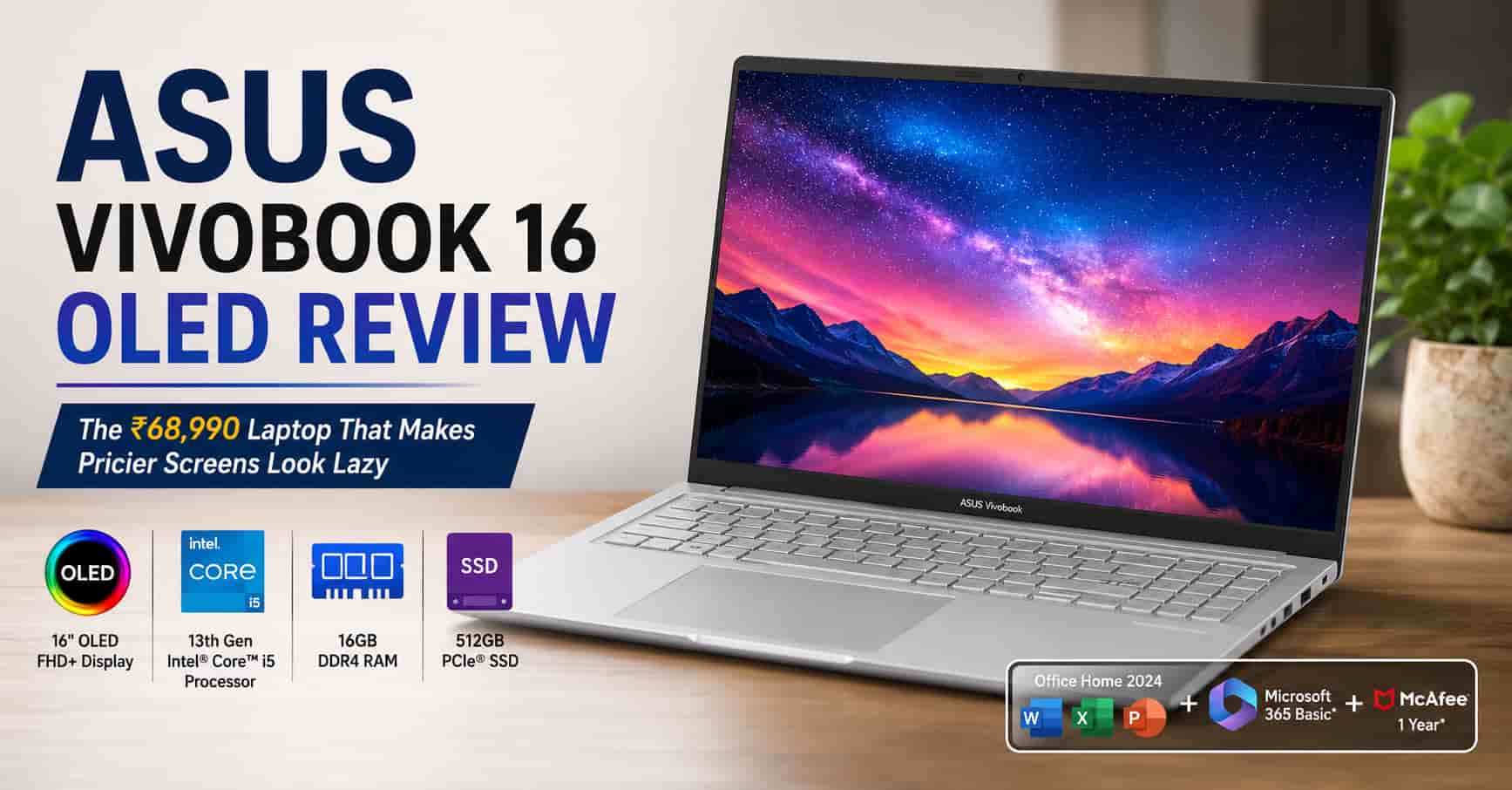
Strip away the marketing language and here’s the core of the machine ASUS Vivobook 16: a 13th Gen Intel Core i5-13420H, an 8-core, 12-thread chip that boosts up to 4.6GHz, paired with 16GB of DDR4 RAM and a 512GB NVMe SSD. That’s a well-balanced combination for a laptop in this price bracket, and it’s not a spec sheet ASUS is stretching thin to hit a number; the components are matched sensibly to each other.
The part that actually separates this Vivobook from the dozen other i5 laptops in the same price range is the display. It’s a 16-inch OLED panel running at FHD+ (1920×1200) in a 16:10 aspect ratio, with 300 nits of brightness and true blacks that only OLED technology can deliver. Most laptops at this price point ship with an IPS panel that looks fine until you put it next to an OLED screen, at which point the difference is obvious immediately, not something you have to squint to notice.
Where this laptop earns its price tag
The screen is the headline, and it deserves to be. Colours are accurate rather than oversaturated, black levels are genuinely black instead of the washed-out grey you get on cheaper panels, and the 16:10 aspect ratio gives you noticeably more vertical space than a standard 16:9 screen, which matters more than people expect once you’re scrolling through documents, spreadsheets, or long web pages all day.
It’s built for people who actually work on their laptops. The backlit chiclet keyboard includes a dedicated numpad, which is a small thing until you’re the person constantly entering numbers into spreadsheets and realize how much faster it is than reaching for the number row. Connectivity is generous too, you get a USB-C port with power delivery, two USB 3.2 Type-A ports, HDMI, and Wi-Fi 6E, so you’re not stuck buying a dongle on day one.
The software bundle quietly adds real value. Microsoft 365 Basic with 100GB of cloud storage for a year, plus Office Home 2024 with lifetime validity, plus a year of McAfee, these aren’t throwaway trial versions bundled in to pad the listing. If you were going to buy Office separately, that alone offsets a meaningful chunk of the laptop’s price.
At 1.88kg, it’s genuinely portable for a 16-inch machine. Big-screen laptops usually mean big weight, but this one doesn’t punish you for wanting the extra display real estate.
Also, read | Moto Pad 70 Pro Launched in India at ₹32,999 – Snapdragon 8s Gen 4, Free Stylus, and a 13-Inch Screen
Where you should adjust your expectations
No laptop in this price range is without trade-offs, and this one has two worth knowing before you buy.
The 60Hz refresh rate is the biggest one. OLED displays this vivid often come paired with 90Hz or higher refresh rates on other laptops, and this one doesn’t, scrolling and everyday motion won’t feel as fluid as it might on a gaming-oriented machine. For document work, browsing, and video, you won’t notice. For fast-scrolling content or anything performance-sensitive, you will.
The integrated Intel UHD graphics mean this isn’t a laptop for gaming or GPU-heavy creative work like serious video editing or 3D rendering. It’ll comfortably handle photo editing, light video trimming, and every productivity task you throw at it, but if your work involves rendering timelines or playing modern titles, you’ll want a machine with a discrete GPU instead.
Who this laptop is actually built for
I’d point three types of buyers toward this one specifically:
- Students and professionals who live in documents, spreadsheets, and browser tabs all day, the screen, keyboard, and included Office suite are tailored almost exactly to that workflow.
- Anyone who consumes a lot of video or photo content on their laptop, an OLED panel at this price is genuinely uncommon, and it changes how everything from YouTube to your own photo library looks.
- People who want a big display without hauling around a heavy machine, 16 inches at under 1.9kg is a combination most competitors don’t offer.
I would not recommend it to anyone shopping specifically for gaming performance or GPU-intensive creative work; that’s simply outside what this configuration is built to do, and no amount of RAM or SSD speed changes that.
The bottom line
At ₹68,990, the ASUS Vivobook 16 OLED isn’t trying to be the fastest laptop in its price bracket, it’s trying to be the one with the best everyday experience, and on that front, it delivers. The display alone justifies a closer look, and the bundled software licenses mean you’re not just paying for hardware. If your daily laptop use is productivity-heavy with a side of video and photo consumption, this is one of the stronger options currently available at this price point.
View the full listing and current price on Amazon →
Affiliate disclosure: This post contains an Amazon affiliate link. As an Amazon Associate, I earn from qualifying purchases made through this link, at no additional cost to you. Prices and specifications were accurate at the time of publishing but may change, please confirm the current price and configuration on the Amazon product page before purchasing.
Latest Posts
Poco X8 and Poco X8 Power Launched in India: Price, Specifications, and Which One You Should Actually Buy

Nvidia Acquires Hugging Face for 13 Billion Dollars: Here’s Why This Deal Matters
Vivo T5 India Launch: Price, Specifications, and Everything Worth Knowing Before You Buy
iPhone 18 Pro and iPhone Ultra Expected Launch: Everything Reportedly Coming This September

iPhone 17 Pro Price Drop on Flipkart: Get It for Rs 81,000 With Exchange and Bank Offers

Best AirPods Case Options in 2026: Top 5 Picks Worth Buying Right Now
Moto G Max Launched in India: Price, Battery, Camera and Full Specifications

Fitbit Air India Launch Confirmed: Price, Specs, and Everything You Should Know

Pixel 11 Series Launched in India: Price, Specs, Tensor G6 Chip and Everything Else You Should Know
Redmi Note 17 5G India Launch: Price, Sale Date and Everything You Need to Know
iQOO Z11 India Launch Set for August 20: AI Features, New Design, and What to Expect